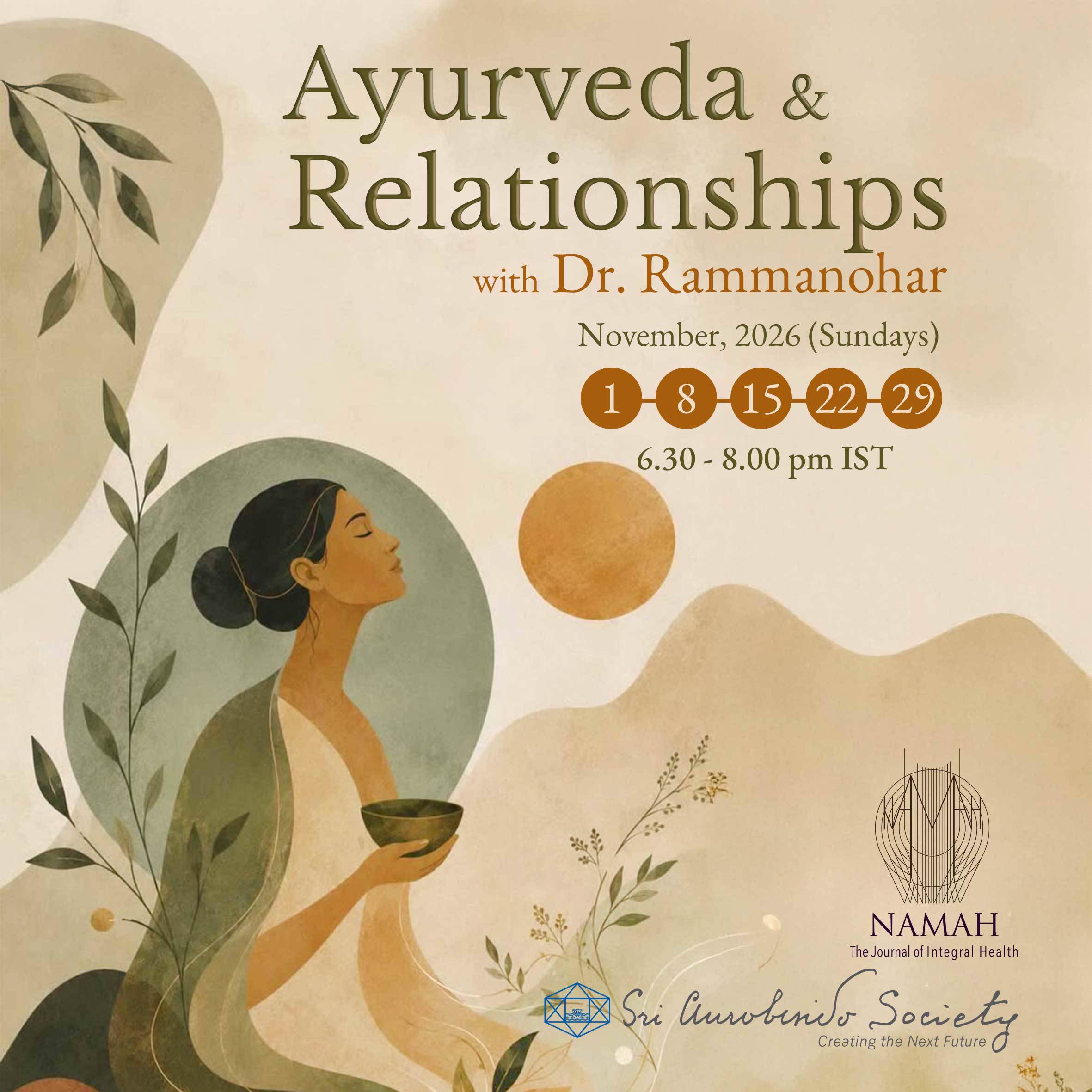
The Central Idea
Ayurveda offers a profound vision of relationships: to see oneself in the other and the other in oneself.
Ātmavat satataṃ paśyed api kīṭa-pipīlikam — “Let one constantly see even the smallest creatures as oneself.”
Healthy relationships therefore begin not merely with understanding another person, but with understanding who we ourselves are. Ayurveda invites us to distinguish the deeper Self from
Prakṛti, personality and social roles. We need our roles to live in the world, but we need not mistake those roles for our true identity.
The five sessions explore this journey from Self → Other → Relationship → Role → Integration.
SUNDAY 1: WHO AM I?
The Self Behind the Relationship
- The Ayurvedic understanding of
Puruṣa and
Ātman
- Body, mind, senses and consciousness
-
Prakṛti and individual differences
- Identity and the sense of “I”
- The Self and the personality
- Why understanding oneself is the foundation of relationship
Central question:
Who is the “I” that enters into a relationship?
SUNDAY 2: SEEING THE SELF IN THE OTHER
The Ayurvedic Foundation of Relationship
-
Ātmavat Satatam Paśyet
- Seeing oneself in others
-
Loka–Puruṣa correspondence
-
Sarvalokam Ātmani — the Self in all and all in the Self
- Empathy, compassion and connectedness
- From “the other” to “another self”
- Relationship as an expression of a deeper unity
Central question:
What changes when I truly see myself in the other?
SUNDAY 3: THE SELF AND THE MASK
Prakṛti, Personality and the Roles We Play
- Prakṛti as the framework of individuality
- Personality, temperament and behaviour
- The many roles we assume in life
- Parent, child, spouse, friend, teacher, student and professional
- The mask is necessary—but it is not the Self
- Distinguishing identity from role
- Learning to wear the mask without becoming the mask
Central question:
Can I play my role completely without forgetting who I am?
SUNDAY 4:
LOVE, ATTACHMENT AND CONFLICT
When We Confuse the Person with the Role
- Attraction, attachment and aversion
-
Rāga and
Dveṣa
- Expectations and projections
- Possessiveness and identification
- Anger, disappointment and conflict
- Seeing the person beyond the image we have created
- Compassion and
Sadvrtta
- Transforming reaction into conscious response
Central question:
Are we relating to the person—or to the image we have created of the person?
SUNDAY 5:LIVING IN THE WORLD WITHOUT LOSING THE SELF
Relationship as a Path of Growth
- Knowing the Self
- Knowing the mask
- Performing one's role consciously
-
Svārtha and
Parārtha
- Compassion, responsibility and appropriate conduct
- From individual well-being to collective well-being
- Seeing the Self in all beings
- Relationship as a path toward harmony and transformation
Central question:
How can we live fully in the world without losing ourselves in our roles?
THE JOURNEY
Know the Self
↓
Recognise the Self in the Other
↓
Understand the Mask of Prakṛti
↓
Play the Roles Consciously
↓
Transcend Identification
↓
Live in Relationship with Awareness and Compassion
A concluding thought
We do not transcend relationships by abandoning them. We transcend their limitations by discovering the Self that is present in both the “I” and the “other.”
To join:
From India: Rs. 3,600
FOR BANK TRANSFER
Account: NAMAH, Acc no: 1235498160, Type: Savings, Central Bank of India,
IFSC: CBIN0281354
CONTACT DETAILS: james@namahjournal.com +917094898789 & (0413) 2226263